Stories, Staff stories
2nd Oct 2026
Hospice Care Week: Leigh’s Story
This year’s Hospice Care Week (5 – 11 October 2026) theme – Don’t leave hospice care to chance – is a reminder that while everyone deserves access to compassionate care and support right to the end, hospices are underfunded and under more pressure than ever.
Throughout the week, we’re sharing stories from across St Mary’s and introducing you to some of the people who make a difference – the people who don’t leave hospice care to chance.
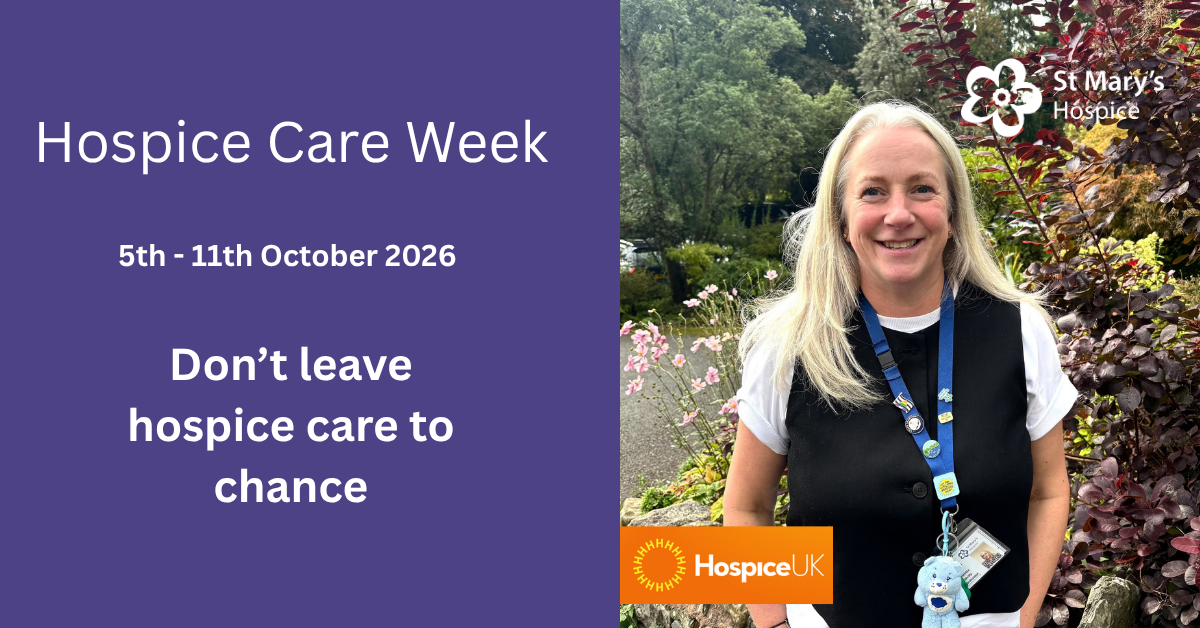
Leigh is a Dementia Activities Coordinator at St Mary’s Hospice. After a 20-year career in fashion, she moved into the care sector following the experience of seeing the care her late dad received at a hospice before his death.
Leigh studied fashion at university before working as a fashion buyer.
Sadly, in 2018, her dad was diagnosed with a brain tumour and was cared for at a hospice in Essex.
“The whole process, which was only about four months in total, changed me forever,” said Leigh. “The whole experience of him being in the hospice, seeing how much it matters to people and how much you can help and change lives made me want to do something similar myself. There were so many small moments that really made a difference, and it sparked something in me.”
Leigh went on to become a carer and discovered her passion for working in dementia care.
“I really enjoy working with and supporting people impacted by dementia; it’s an absolute honour,” she continued. “We make people feel comfortable and completely safe. I feel really lucky to work at St Mary’s, a hospice that has the vision to keep people well and support people on their journey through dementia. We are forward-thinking in our care, and we’re always growing and learning.
“Our teams are amazing, from the clinical team at our in-patient unit to those I work alongside in our community services team.”
The memories of her dad’s hospice care are something Leigh carries with her as she now makes a difference to the lives of people and families herself.
She said: “Hospice care is so personal, and it makes a tough time so much better. People really get to know you and your family. Mum went to see Dad every single day, all day, and it was never an issue.”
Working in dementia care means Leigh experiences small moments of joy, connection and hope every day. One memory that stands out is from the Dementia Unmuted Festival in Millom: “One of the attendees chose to stand up and express how much the group had helped her. She explained how thankful she was to us for delivering a group in her area. It was so touching and special. We get a lot of thanks, and they are so genuine, and every one means a lot.”
For Leigh, the experience of hospice care has come full circle. Having seen first-hand the difference compassionate care made to her own family, she now helps create those moments of connection, comfort and support for people living with dementia and their families.

© St Marys Hospice 2026 |
|
Registered Charity Number: 517738
Web design by Creatomatic